Gioachino Rossini’s name appears frequently on the Mariinsky Theatre’s programme: The Barber of Seville, Le Comte Ory, La Cenerentola, and L’Italiana in Algeri are all part of its repertoire. When Alexander Pushkin compared Rossini’s music to the golden bubbles of champagne, he had precisely this lyrical and comic side of the composer’s genius in mind. Yet the “Swan of Pesaro” chose to conclude his artistic career with a work of an entirely different nature. The “ever the same, ever new” composer created a masterpiece in which the sunny Italian cantilena is combined with the noble pathos and spectacular scale of French theatre: Guillaume Tell (William Tell, 1829).
The work of the “Italian Mozart,” written in French about a Swiss hero and based on a drama by a German writer, is international in origin yet patriotic in spirit. It rises like a monumental landmark above the musical and theatrical landscape of the 19th century. In its scale, William Tell is comparable to the panoramic canvases of Meyerbeer and the epic dramas of Wagner. The “darling of Europe” created a score demanding enormous artistic and technical resources. Although Rossini’s opera has considerably fewer characters than Schiller’s play of the same name, it is still remarkably populous. More than half of its two dozen musical numbers are choruses.
The action takes place at the beginning of the 14th century, when the “forest cantons” are fighting for independence from Habsburg rule. On the surface, the plot contrasts the Swiss people with their Austrian conquerors, but Rossini goes much deeper. His Swiss are not an undifferentiated mass, but a multifaceted and diverse society. His collective portrait of Alpine life includes peasants, fishermen, shepherds and hunters, with the character of each group reflected in the music.
The opera’s title character is not a superhuman hero who defeats the enemy single-handedly, but a leader of his people. Significantly, Rossini introduces Tell within the context of his community: the character has neither a conventional opening cavatina nor a major “concert” aria designed to showcase the singer’s virtuosity. His only relatively extended solo is the arioso Sois immobile. “Stand still,” a father tells his son before shooting the apple; even Wagner, famously dismissive of Italian opera, was captivated by this melody, describing it as “free, unbound, responding in many ways to the meaning of the poetic text.”
Although a love story runs through the entire epic, its role is largely decorative. There is no conventional love triangle; its symbolic third point is Switzerland itself. A Swiss man in love with an Austrian woman is forced to make a difficult choice.
At the same time, Rossini’s demands on the singers performing Arnold and Mathilde are exceptionally high. Many theatres could not afford to stage William Tell simply because they lacked a tenor capable of singing, after the considerable vocal demands of the preceding acts, the Act IV aria Asile héréditaire (“My Fatherland”), with its repeated high Cs. Over the course of the evening, Arnold must reach the high C no fewer than nineteen times.
For any opera company, William Tell is a challenge and an ambitious artistic undertaking – one that is both demanding and rewarding to bring to the stage. At the Mariinsky Theatre, Rossini’s final opera is being prepared by distinguished Italian director Giancarlo del Monaco, whose Aida was a major event of the 2024–2025 season and received the Golden Mask award. William Tell is being staged in Russia for the first time in the original language.
Christina Batyushina
Synopsis
The story takes place in Switzerland in 1308.
ACT I
A square in front of William Tell’s house in a Swiss village on the shores of a mountain lake. The peasants are preparing for a traditional festival during which marriages are celebrated. A young fisherman, sailing in a boat, calls out to his beloved. Only William Tell is sombre. The famous marksman and hunter laments the fate of his homeland, oppressed by the hated Austrians.
Tell’s wife, Hedwige, and his son, Jemmy, anxiously watch the boat: the mountain lake can be dangerous. The village elder, Melcthal, appears with his son Arnold. Everyone greets the respected shepherd, who is to bless three young couples. Melcthal would like his own son to marry as well, but Arnold is forced to conceal his feelings. He is in love with Princess Mathilde of the House of Habsburg, the enemies of Switzerland. To be closer to the woman he loves, the elder’s son has even joined the enemy army.
Tell understands the reason for Arnold’s inner torment. He urges his friend to serve his country rather than his passions. Arnold is torn between his love for Mathilde and his duty to his homeland.
The sound of a horn is heard: it is Gesler, the Habsburg governor, out hunting. Arnold flees. Tell’s son Jemmy wins the archery contest, proving himself as accurate a marksman as his father.
Leuthold, a Swiss shepherd, appears. He has killed one of Gesler’s soldiers while defending his daughter’s honour. Now Gesler’s men are pursuing him. Leuthold asks a fisherman to take him across the lake, but the waves are too high. Only the brave Tell is willing to save him. The villagers pray for their safe passage across the stormy waters.
As soon as the boat sets off, a detachment of Gesler’s men appears under the command of Rudolph. The villagers refuse to reveal Tell’s whereabouts. Rudolph orders Melcthal to be arrested and the village to be set on fire.
ACT II
A mountain gorge at evening. Hunters and shepherds make their way home. Mathilde has fallen behind the hunting party to meet Arnold. She praises the beauty of nature, which she prefers to the splendour of palaces.
Arnold appears. He speaks of the social inequality that stands in the way of his union with his beloved. Mathilde assures him of her love and urges him to perform a heroic deed that will make the son of a Swiss elder worthy of an Austrian princess’s hand.
William Tell and Walter Fürst approach. They have noticed Mathilde fleeing. Tell accuses Arnold of treason, while Fürst tells him of his father’s death: the old man Melcthal was executed on Gesler’s orders. Arnold is devastated. Together with his compatriots, he swears to avenge his father’s death.
Under cover of night, peasants from different cantons gather. The Swiss swear to fight for the freedom of their homeland.
ACT III
Arnold and Mathilde meet in a chapel. Arnold tells his beloved that he must avenge his father’s death. Mathilde is heartbroken, and the lovers part.
A commotion is heard outside as the Austrian military camp awakens. In the market square before Gesler’s residence in the city of Altdorf, the people gather. Gesler has ordered a celebration to mark the centenary of the Austrian conquest of Switzerland. Every Swiss citizen is required to bow before the Austrian coat of arms and Gesler’s hat. The conquerors force Swiss women to dance with them.
William Tell and his son Jemmy are also forced by the soldiers to approach the pole on which Gesler’s hat has been placed. Tell refuses to bow his head, and Rudolph takes him before the governor.
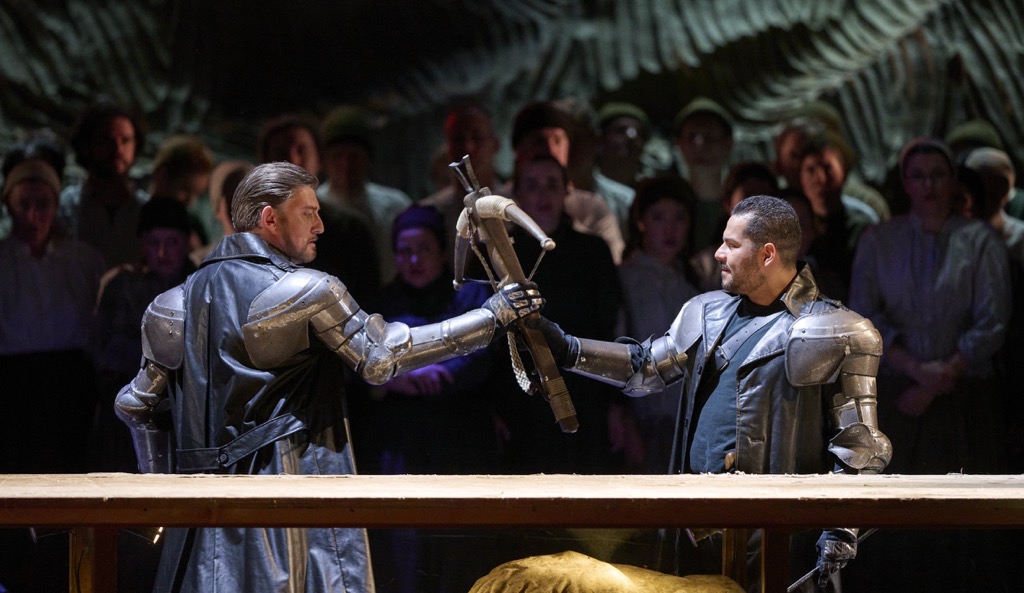
Gesler and Rudolph threaten Tell with death. The marksman urges his son to flee, but Jemmy is prepared to die alongside his father. When Gesler notices the strength of Tell’s paternal feelings, the tyrant devises a cruel punishment. He orders William to shoot an apple from his own son’s head.
Tell blesses Jemmy and commands him to stand perfectly still. The arrow pierces the apple, but Gesler notices that Tell has a second arrow. William had prepared it to kill the governor if Jemmy were to die.
Gesler orders father and son to be arrested. Mathilde intervenes on the boy’s behalf and escapes with him. The people curse the tyrant.
ACT IV
At his family home, Arnold remembers his childhood and his murdered father. When he learns that William Tell has been arrested, he sets out with a group of Swiss to rescue his friend.
On the lakeshore, near Tell’s house, Jemmy and Mathilde appear. The princess entrusts the boy to Hedwige. Mathilde has sided with the oppressed people and is prepared to remain among the Swiss as a hostage in exchange for Tell’s life.
Leuthold announces that Gesler is taking William to a prison on an island in the middle of the lake. Jemmy sets fire to the roof as a signal for the uprising to begin. The Swiss gather.
A violent storm rages across the lake. The boat carrying the prisoner is on the verge of being smashed against the rocks. The helm falls into the hands of the prisoner. Near the rocks, William manages to leap from the boat onto a rocky ledge. Jemmy brings his father his weapon, and Tell’s arrow finds Gesler.
The enemies retreat. Arnold announces that Altdorf has fallen into Swiss hands. The storm subsides, and the people celebrate their long-awaited freedom.